
The night clung to the hull like soot.
Inside the T-34, the air was thick with old smoke and men’s breath. Metal creaked as it cooled and reheated in the dark; engines coughed awake in the distance, one after another, until the steppe hummed like some great animal drawing breath.
Bargideon lay with his back against the turret wall, knees bent, boots braced on the loader’s crate. The steel still held warmth from the last run they’d made the day before. He could feel it through his ribs like the lingering fever of a man who refuses to die.
Lev Petrov — Lyova to everyone who needed something heavy lifted — snored in short uneven bursts on the hull floor, head pillowed on a rolled tarp. Sasha Morozov, the driver, had somehow fallen asleep half-curled in his seat, chin on chest, hands still resting on the levers as if afraid the tank might slink off without him. Misha Antonov, the gunner, sat with his back to the breech, eyes open, rosary wound so tight around his fingers that his knuckles showed white even in the gloom.
Bargideon watched them in the dim red light from the instrument bulbs, as a priest might study the faces of his congregants before the sermon none of them wanted to hear.
They were already dead men in one possible future.
He had seen enough futures to know that.
He closed his eyes and listened instead.
Engines rumbling in the distance. Clanks of tools on hulls. Low laughter. The flat slap of a boot on frozen mud. Somewhere to their right, a man playing a harmonica badly and another telling him to shut up. The night before a battle always sounded the same, no matter the century, no matter the army — a mix of denial and ritual, of men pretending the dawn would be like any other.
“Komandir,” Misha said quietly, voice low to avoid waking the others. “You’re not sleeping.”
Bargideon opened his eyes. In the dimness, the gunner’s face was all angles and shadow, his icon glinting at his neck like a watching eye.
“I’ve slept through too many dawns I should have remembered,” Bargideon said. His Russian had a slight edge to it still — vowels flattened by Norwegian winters — but the crew barely heard it anymore.
Misha smiled a little. “You sound like my grandmother when you speak like that.”
“Your grandmother commanded a tank army?” Barg asked.
“No. She commanded the entire village,” Misha said. “Much worse.”
They shared a brief, quiet laugh that never reached full strength. The sound died against the steel.
Outside, another engine roared to full power, then settled into a steady growl. Closer now.
“How many days has it been?” Misha asked.
“Since what?” Bargideon said.
“Since the first shells at dawn, since the mines, since the Germans came in earnest. It feels like we have fought a year in a week.”
“Seven days,” he said. “Five since we first fired from this gun. Three since Lyova decided he is immortal.”
From the floor, the loader grunted without opening his eyes. “I heard that,” he muttered. “Immortal, yes. Deaf, no.”
Sasha snorted, half asleep, half awake. “Immortal? Then you can sit on the glacis when the Tigers start shooting, Lyova. I will stay inside with the cowardly mortals.”
“You’ll stay where I tell you,” Bargideon said, softer than the words deserved. “And you will keep us alive as you did yesterday.”
Sasha straightened reflexively, even in his seat. “Da, komandir.”
He was the youngest of them, cheeks still unable to decide if they wanted to grow a proper beard. The war had aged his eyes faster than his skin. Bargideon sometimes thought of him as a small boy sitting at the helm of a great iron beast, pretending to be its master and not its sacrifice.
Bargideon shifted, feeling the ache in his own muscles. He had worn many uniforms – colors, cuts, flags changed – but the weight on his shoulders never did.
He reached over and rapped the turret wall lightly with his knuckles.
“Wake up fully,” he said. “All of you. It will be dawn soon. And dawn will not wait on our comfort.” Though his tank and crew were new, they had already shared much action triumphantly.
Lyova sat up, rubbing his eyes with meaty fists. “Unless the Germans oversleep,” he said. “You think the fascists might be late?”
“They are German,” Misha said. “They will be on time.”
“Then I curse their punctuality,” Lyova grumbled. He began checking shells, his movements practised and precise despite the complaining. “High-explosive, armor-piercing, armor-piercing, high-explosive… Do you remember when we had mostly HE shells and were told that was enough?” He smirked, pushing one round back into its rack. “Now they give us real teeth. Tigers must have made someone in Moscow nervous.”
Bargideon watched the loader’s hands move over the ammunition. Each shell was a decision not yet made. Each held the possibility of life or death for some man he would never see.
“Komandir,” Sasha said suddenly. “Do you truly think we will meet the Tigers today? Face to face?”
He listened again — to engines, to far-off clanking, to the rumor carried on the cold air. To the small, bitter certainty in his bones.
“Yes,” he said simply. “We will.”
“And we will kill them,” Lyova said, too quickly. “Rotmistrov wouldn’t throw us like peasants with sticks. We have T-34s, we have numbers. We will swarm them. Like wolves.”
“That is what wolves do,” Bargideon said. “They bleed at the muzzle and bite anyway.”
He pictured the field as he had seen it from his hatch the previous day: the gentle folds of the land, the cutting line of the railway embankment, the Psel River glinting to the north. The Germans had pushed hard; SS armor had carved its way forward like a knife through cloth. Now they sat in that narrow corridor, expecting to finish their work.
But the Motherland had held something back.
An entire guards tank army, engines cooling in the darkness.
Bargideon had seen this pattern before. At Narva. At other rivers, other ages. Let the enemy drive deep, then strike him as his arms tire. A simple doctrine, but simplicity hides a cruelty: it uses ground as bait, and men as the hook.
He wondered, not for the first time, whether this too was Providence — or simply the logic of beasts trapped in the same cage.
“Friedrich,” Misha said quietly, using his name instead of “komandir” for once. “You are doing that thing again.”
“What thing?”
“Your eyes go distant,” the gunner said. “As if you see something behind the steel. I do not like it.”
“Superstitious bastard,” Lyova muttered. “Let the man think. As long as he tells us where to shoot, he can stare at ghosts all he wants.”
“There are always ghosts,” Friedrich Bargideon said in Norwegian before he could stop himself. The words came out low and rough, meaningless sounds to the others. He shifted back to Russian. “There are always dead men watching. We just pretend we don’t see them. It keeps our hands from shaking.”
Sasha crossed himself quickly. “Now I will see them too,” he grumbled.
“Good,” Bargideon said. “If you drive as if the dead are watching, you will not shame them.”
The driver snorted but said nothing more.
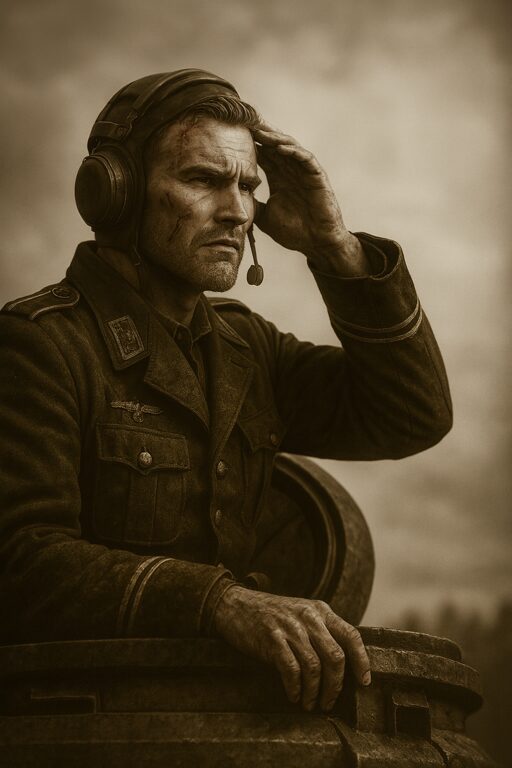
The tank shivered as Bargideon reached up and cracked the hatch above his head. A wedge of icy air slid in, smelling of oil, frost, and distant exhaust. He pulled himself up, half-standing in the cupola, shoulders above the rim, head still just below hatch level. Outside, the world was not yet light, but the east was smudged with a faint grey that promised sunrise.
He could see rows of dark shapes in the gloom — other T-34s, parked hull-to-hull in loose lines. Men moved between them, shadows against shadows. Cigarette embers glowed like fallen stars. Somewhere a truck backfired; somewhere else, an officer’s voice cut through the murmur in clipped commands.
And beneath it all, constant and growing, the rumble of hundreds of engines idling.
Bargideon laid a gloved hand on the rim of the cupola and closed his eyes for a moment, letting the sound roll through him.
I have heard this before, he thought.
When the chariots massed on plains without names.
I heard it when the first tanks clattered at the Somme.
I will hear it again when someone, somewhere, decides this was not enough.
“Komandir!” a voice called from the night.
Bargideon opened his eyes. A figure approached through the half-dark, heavy coat flapping, cap pulled low. It was Captain Voronin, company commander, his breath steaming in the air.
“Bargideon,” Voronin said, voice low but urgent. “You and your wolves ready?”
“We are not wolves,” Lyova called from inside. “We are stubborn cows with cannons.”
Voronin peered up, smiled briefly. “Good. Stubborn cows are hard to move. Listen.” He hooked a boot on the track and leaned close, speaking for Barg alone. “Orders from higher. Rotmistrov himself. We are to strike as soon as the light is good. Maximum speed. Close range. Do you understand?”
“Ram the spear down their throat before they can swing it,” Bargideon said.
“Exactly. Our scouts report SS armor dug in ahead. Tigers, Panzers, anti-tank guns. They will try to kill us at range. So we deny them range.” Voronin’s eyes shone with a hard light. “We rush them. Our numbers, their surprise — we crush them in their positions. The Motherland will remember this day.”
The Motherland will remember the number of dead as well, Bargideon thought. But he only nodded.
“We lead the second wave?” he asked.
“First,” Voronin said. “Your platoon on the right of my lead. Morozov knows the ground. Stay near the railway embankment; it will screen you from some of their fire. Once you’re close, it won’t matter. It will be… chaos.” He said the last word like a man who had already resigned himself to it.
“There are worse things than chaos,” Bargideon mused.
Voronin snorted. “Name one.”
“Certainty,” Bargideon replied.
The captain stared at him for a moment, then shook his head. “Your Norwegian philosophy gives me a headache, Friedrik.” He mispronounced the name as he always did. “Just kill Tigers for me. As many as you can.”
“I will try not to disappoint you,” the Norwegian said.
Voronin clapped the turret, then moved off into the gloom, shouting orders to another crew.
Bargideon slid back down into the turret, shutting the hatch partway to keep the heat in.
“Well?” Lyova said. “Do we live forever, or only until lunchtime?”
“First wave,” Bargideon said. “We charge as soon as there’s enough light to see the muzzle flashes killing us.”
Sasha swallowed audibly.
Misha closed his eyes and kissed his icon.
Lyova grinned a grin with too many teeth. “Good,” he said. “I hate waiting.”
Bargideon settled into his place, headset on, throat pressed against the rough wool of his collar. He tapped Sasha’s shoulder.
“Engine,” he said.
The driver hit the starter. The T-34 shuddered as the diesel coughed, sputtered, then roared to life beneath them. The hull vibrated, familiar and comforting in its violence. Dust drifted down from unseen corners, stirred by the tremor.
Bargideon listened to the engine, to its rhythm, for sickness or weakness. It hummed like a beast eager to run.
“Transmission?” Bargideon asked.
“Responds well,” Sasha said, testing the levers, eyes flicking over the gauges.
“Gun?” He said.
Misha moved the elevation and traverse, sighting down the optics, making tiny adjustments. “Smooth,” he said. “No stiffness. As if we have not spent a week firing it like madmen.”
“Loader?”
Lyova slapped a shell with affection. “She is hungry, komandir,” he said. “And I have laid her table.”
Bargideon nodded, unseen in the cramped metal.
“Then we go to meet our guests,” he said.
He opened the hatch again and rose into the cupola, binoculars bouncing from his chest as the tank lurched forward under Sasha’s careful hand. Around them, other T-34s began to move — first in hesitant jerks, then with growing confidence, tracks biting the earth, exhaust pouring behind them in long grey banners.
The eastern sky was lightening now, a faint, cold blue leaking into the black. The line of the railway embankment was a darker scar against the horizon. Beyond it, Bargideon knew, lay German guns that had spent the past week tearing pieces from Soviet flesh.
He raised his binoculars, scanning the fields ahead. At first he saw only the rolling land, the stubble of crops, the low mist. Then — faint, almost imagined — he caught the angular shapes of hulls dug into the ground, turrets barely visible. A line of crouching beasts facing west.
Tigers.
And other Panzers, smaller but no less deadly in the right hands.
“Contact,” he murmured into the throat mic, his voice calm. “Enemy armor hull-down, ahead, two thousand meters. They see us soon, if not already.”
“Already,” Misha said. “They have eyes too.”
Far off, a single muzzle flash bloomed, a brief flower of fire against the pale sky. A moment later, the distant thunder reached them, and a shell screamed overhead, too high, stirring only panic in the clouds.
Then a second flash. Then a third. A line of them, like a string of sunrise lit from below.
“They hurry,” Lyova said, his earlier bravado thinner now.
“Good,” Bargideon said. “The hasty shot is seldom the truest.”
Ahead, Voronin’s tank surged forward, signal flag rising from his cupola, then dropping: attack.
“Full speed, Sasha,” Bargideon ordered. “Stay close to the embankment. We use it as much as it will allow.”
The tank leapt as the driver applied more throttle, gears grinding briefly, then catching. The ground blurred beneath them. The vibrations increased, rattling teeth and thoughts.
“Keep low until I tell you,” He said to the crew. “Misha, hold your first shot. We fire when we can see paint, not silhouettes.”
“That close?” the gunner asked.
“That close,” Bargideon said. “We are not here to trade salutes with Tigers. We are here to get inside their comfort and kill them. Let them have their precious optics. We will give them our blind rage.”
He felt it then — the old, familiar split in himself.
One part was the tank commander, calculating ranges, angles, the rise of the ground, the timing of their charge versus the enemy’s reload cycle. The other part was the War Walker, standing slightly aside from his own body, watching the scene unfold as if on a stage he’d seen performed in different costumes a hundred times.
He saw Agincourt in the mud and arrows.
He saw the Somme in the machine-gun nests and men walking into them.
He saw Narva, snow and blood blending, men shouting in languages long dead.
He saw, above all, the same equation:
Pride + Desperation + Steel = Piles of bones.
“Friedrich,” Misha’s voice came through the headset. “You’re doing it again.”
“Good,” Bargideon said. “Maybe this time I’ll remember something useful.”
Another shell hit the ground fifty meters to their left, carving a crater and throwing up a fountain of earth and smoke. The tank rocked slightly from the shockwave. Dirt rattled against the hull.
“Lyova,” Bargideon said. “AP ready.”
“Armor-piercing in the tube,” the loader confirmed, breath already slightly faster.
They thundered on.
The distance shrank. Two thousand meters. One thousand eight hundred. One thousand five hundred. German fire became denser, more willing to guess.
A T-34 to their right exploded suddenly, turret lifting as if yanked by an invisible hand. Flame and metal vomited skyward; the hull wheeled drunkenly, then collapsed into fire. Bargideon caught the sight in a glance, swallowed the sharp sting in his chest, and rode it down into ice.
Name later. Orders now.
“Do not look,” he said quietly into the mic. “Watch only what we can kill.”
Sasha did not answer. His knuckles on the levers were white.
“One thousand two hundred,” Misha murmured, reading range marks. “We are almost in their favored zone.”
“I am aware,” he said dryly. “Sasha. Closer still. We make them too nervous to aim like their manuals say.”
“That is a very bad idea,” Sasha said.
“Yes,” Bargideon replied. “It is also the only one.”
He straightened fully in the cupola, exposing more of himself. The air up here felt brutally clean after the diesel-heavy interior. Wind knifed his face, carrying the sharp stink of explosives and torn soil.
Ahead, he could now see the Tigers clearly — squat, brutal silhouettes with long guns, muzzle brakes flaring as they fired. They sat in carefully chosen positions, hulls half-buried, presenting only thick, sloped armor to the oncoming Soviet wave. They were killing machines, and they knew it.
And still, behind them, the line of T-34s surged forward, raising a wall of dust and smoke that partly, blessedly, obscured them.
“Now,” he said quietly. “Now we make them choke on their own certainty.”
He dropped back down enough to see through Misha’s sight, steadying himself with a hand on the turret ring.
“Target?” Misha asked.
“Tiger, left of the broken oak,” Bargideon said. “Hull-down. Range eight hundred. Wait for my mark. We fire when his muzzle flashes. Catch him as he breathes out.”
The tank bucked over a shallow ditch. Lyova swore as he braced himself, arms locked around the heavy shell already waiting.
“Steady,” Bargideon murmured. “Sasha, slight left. Yes. Hold this line. Do not slow unless we are burning.”
“I will remember that,” Sasha said.
A moment later, the Tiger’s gun flashed again. The world narrowed to the bright instant of muzzle flare and the feeling of recoil waiting in the steel around them.
“Now!”
Misha squeezed the trigger. The T-34’s gun roared, the inside of the turret slamming with sound and force. Lyova was already reaching for the next round as the first shell screamed away.
Through the periscope, Bargideon thought he saw a brief impact against the Tiger’s mantlet, a spark, a shudder in the enemy’s turret. Then smoke, black and greasy, beginning to seep from the back of the German tank.
“Hit,” Misha breathed.
“Not enough,” Bargideon said. “Again. We will remove its arrogance piece by piece.”
“AP!” Lyova shouted, slamming the next shell into the breech. “Loaded!”
Behind them, a second Soviet tank died, track blown off, hull spinning helplessly as another hit punched through its side. Men bailed out, some crawling, some on fire. Another shell, from somewhere else, finished them.
“Forward,” Bargideon said again, as if the only direction left in the universe was toward the enemy.
And for that morning, it was.
They plunged deeper into the cauldron, where tank and tank collided not at range but at spitting distance. Where friend and foe were sometimes separated only by the angle of armor and the worn pattern of a uniform. Where doctrine dissolved into instinct, and men fired at any muzzle that spat flame in their direction.
Through it all, Friedrich Bargideon felt time stretch and fold around him — the moment elongating, every decision an echo of something he had done, or would do, elsewhere, elsewhen.
He heard Lyova laugh once, wild and terrified, as they skimmed past a burning Panther, close enough to feel the heat bake their paint.
He heard Sasha mutter prayers and curses together, as if hedging bets, and Misha whisper the names of saints and dead comrades between shots.
He heard, beneath all of it, the one sound that never changed:
the hungry, grinding song of war itself, devouring another generation whole.
As the sun finally cleared the low horizon and poured its light over Prokhorovka, Friedrich Bargideon — Norwegian by birth, soldier of the Red Army by circumstance, War Walker by a fate he did not understand — stood half-exposed in his cupola, giving orders into the throat mic, while inside his chest an older voice whispered:
Remember this:
You will walk other fields, in other ages,
and men will tell you this was the last time.
They will lie.
He ducked as a shell exploded close enough to strip the paint from their turret, and the chapter of his life written at Prokhorovka continued in fire.
To be continued…