
Patton, Montgomery, Rommel: Masters of War— Terry Brighton (2009)
(U.S. edition also circulated under the same title; UK origin published as Masters of Battle: Monty, Patton and Rommel.) catalog.cclsny.org
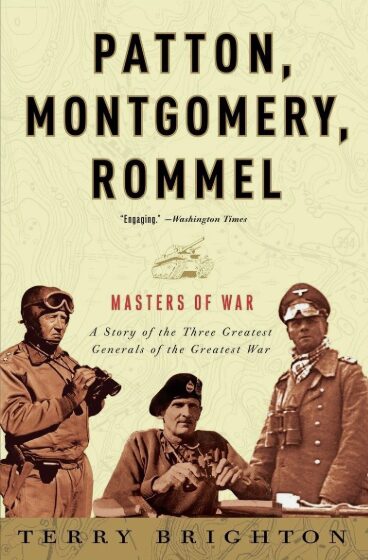
There are few undertakings in military history as audacious as placing three towering commanders of the Second World War into the same analytical frame and expecting each to emerge with clarity. Patton, Montgomery, Rommel: Masters of War achieves precisely that — and does so not by flattening these men into caricatures, but by holding their contradictions and flaws as central to their effectiveness and to the arc of the conflict they shaped. Kirkus Reviews+1
Brighton’s project is deceptively simple: examine how George S. Patton, Bernard Law Montgomery, and Erwin Rommel fought their wars, but also how they wrote their reputations into the narrative of the war itself. He pulls from archives in Britain, Germany, and the United States to place these commanders not only in the battles they fought but in the personal and political waters through which they swam — sometimes with genius, sometimes with blunder. Tantor
Three Commanders, Three Ways of War
At its heart, this is a study of temperament as strategy.
- Patton is presented as the embodiment of audacity — the cavalryman reborn in steel and gasoline, relentless and furious. Brighton resists the Hollywood myth of Patton-the-saintly warrior and instead offers him as a man of contradictions: brilliant in maneuver, combustible in temperament, and obsessed with the glory of action itself. His brilliance came not from calm calculation, but from an almost reckless willingness to trust his nerve and shock his enemy. PublishersWeekly.com
- Montgomery stands in contrast. Meticulous, deliberative, and politically astute, Monty understood warfare as geometry and patience. His victories — most notably at El Alamein — were products of preparation rather than improvisation, and he understood how to harness the machinery of media and public expectation to British advantage. Yet Brighton’s portrait acknowledges that this same caution sometimes bordered on inflexibility, and that Monty’s disdain for his American counterparts did more to fracture coalition unity than it did to win battles. Kirkus Reviews
- Rommel, the “Desert Fox,” is perhaps the most complex of the triumvirate. Brighton neither sanctifies him nor dismisses him. Instead, he shows Rommel’s genius at reading terrain and seizing fleeting opportunities — sometimes beyond the bounds of his orders — while also making clear that his legend was, in part, a product of the very propaganda mechanisms that would later mystify his legacy. Rommel in this book is neither pure genius nor simple myth; he is a commander shaped by circumstance and constrained by strategic reality. Kirkus Reviews+1
Beyond Battles: Relationships and Rivalries
Where this book distinguishes itself from conventional biographies is in its insistence that the “great men of war” did not operate in isolation. Patton’s rivalry with Montgomery became a strategic force in its own right, shaping decisions in Sicily and across the Western Front. Brighton makes a compelling case that the administrative and interpersonal wars fought among Allied leadership had consequences as profound as those on the battlefield itself. Likewise, Rommel’s relationship with his own high command and with Hitler provides a window into the limits of German operational flexibility. Tantor
This is not a mere personality contest. It is a structural reading of how personal ambition, national pride, and command doctrine interact. Brighton pushes us to see that armored warfare was as much about wills as it was about tanks.
Strengths of the Work
Brighton’s narrative thrives because it refuses simplistic moral judgments. These commanders were flawed — violently so. All three courted publicity, all three navigated media landscapes with intention, and all three understood that their legacies would be fought for long after the battles were done. They are shown here not as icons on pedestals, but as actors wrestling with the apparatus of modern war. PublishersWeekly.com
The use of archival material deepens this analysis: Brighton does not repeat received wisdom. Instead, he draws on correspondence, staff reports, and contemporary accounts to challenge assumptions about battlefield intent and consequence. The result is a work that respects historical complexity without losing narrative force.
Limitations
No comparative study can be perfectly balanced, and there are moments when Rommel’s role — especially as the war moves beyond North Africa — feels less fully realized than Patton’s and Montgomery’s. Whether this reflects actual disparity in source material or narrative focus is debatable, but it is noticeable. Yet even this unevenness reveals a truth about the war: the operational focus of each commander diverged sharply as the conflict expanded. WW2DB
Final Assessment
Brighton’s Patton, Montgomery, Rommel does more than recount battles or chronicle personalities. It connects the psychology of command with the mechanics of twentieth-century warfare. This is a book that understands war as a human contest — waged in steel, smoke, and ego alike. It belongs on shelves not simply as narrative history, but as a critical study of how leaders shape, and are shaped by, the crucible of war. PublishersWeekly.com
If there is a single takeaway, it is this: strategy is never divorced from character, and character, in turn, leaves its mark on history. In that unflinching clarity, this book succeeds.
— Friedrich Bargideon
Son of immigrants, keeper of maps, and chronicler of mankind’s most dangerous addiction: war.