
I approached Keegan the way a soldier approaches a veteran instructor: with expectation, and with a certain caution. This is the historian who taught a generation to look past banners and speeches and instead study the texture of fighting and the burdens placed on men in formation. When he turns that lens toward America’s war between North and South, the promise is obvious: a master of military interpretation confronting a conflict that still refuses to sit neatly on anyone’s map.
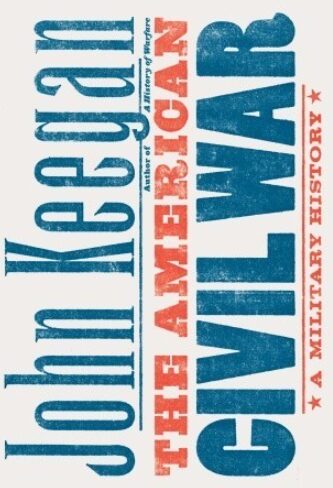
Keegan’s stated key is geography—not as scenery, but as an active force that shapes what armies can do, what commanders can risk, and why victory arrives slowly even when one side possesses the deeper purse and fuller arsenals. That emphasis is not an affectation; it is the spine of the book. James McPherson (no soft judge) captures Keegan’s framework plainly: geography is “the most important of all factors that impinge on war-making,” and North America’s scale and terrain demanded a kind of operational adaptation rarely required elsewhere. Wayback Machine
On that level—war as a struggle against distance, rivers, mountains, roads, weather, and the tyranny of space—Keegan often sounds like himself: lucid, confident, and persuasive.
But this book also carries a second truth: Keegan is writing as an outsider to the Civil War’s dense thicket of American scholarship. At times that distance gives him fresh angles; at other times it exposes him to mistakes that a more embedded Civil War hand would not survive on the page. McPherson’s review is unusually direct: he praises Keegan’s portraits of commanders and the value of the geostrategic approach, then argues the execution is “marred by numerous errors” that can confuse and misinform. Wayback Machine
This creates a difficult but honest verdict: the book contains real insight—and real unreliability. A serious reader can profit from it, but only with discipline.
What Keegan gets right
1) Commanders as psychological weather systems
Keegan is strongest when he writes about commanders as human instruments—fear, boldness, rigidity, patience—because those qualities determine operational tempo long before orders reach the front. McPherson, while cataloging errors elsewhere, still notes Keegan’s “deft turns of phrase” in describing the strengths and weaknesses of principal generals. Keegan’s contrasts between McClellan, Grant, and Lee—between caution that becomes paralysis and aggression that becomes strategic clarity—are exactly the kind of judgment Keegan is built to deliver. Wayback Machine
This is not gossip. It is battlefield math. Armies do not move at the speed of railroads alone; they move at the speed of the man willing to commit them.
2) Geography as the long opponent
Keegan’s insistence that the Civil War was fought across a vast and demanding battlespace—coastline, rivers, mountain chains, interior distances—is one of his most valuable contributions, because it explains duration. Why did the war grind for four years? Why so many engagements, yet so few decisive conclusions? The map itself is part of the answer. McPherson summarizes Keegan’s argument with scale: the Confederacy’s immense area, the long coastline under blockade pressure, the Appalachians as barrier, rivers as defensive and operational features. Wayback Machine
Even when I disagree with Keegan’s handling of specific rivers and terrain features (more on that below), I think his strategic instinct here is correct: this war’s “shape” cannot be reduced to a handful of heroic clashes. The conflict is better understood as a campaign of penetration, control, and collapse across a continent-sized grid, where logistics and mobility slowly became decisive.
3) An ability to situate the war within wider military history
Keegan is often better than many American writers at placing the Civil War within a broader comparative frame—what is “European” about it, what is uniquely American, what foreshadows later industrial warfare. A capsule review in Foreign Affairs points to this strength explicitly, noting Keegan’s ability to capture the degree to which European contexts mattered in understanding the conflict. Foreign Affairs
That outside perspective can be useful. Americans sometimes treat the Civil War as a sealed chamber; Keegan tends to open windows—Napoleonic legacies, evolving communications, and the changing relationship between political leadership and operational command.
Where the book fails its own promise
There is a difference between an interpretive risk and a factual breach. Keegan’s best readers will forgive interpretive daring. They should not forgive avoidable errors, especially when the author’s argument depends on terrain, waterways, and operational geometry.
McPherson’s critique is specific and heavy: he lists repeated confusions about rivers and geography (including mistaken river confluences and placements), errors about forts and terrain features, misstatements about invasions and casualties, even a striking political error about Britain’s prime minister during the war. Wayback Machine That is not a nitpick; it is a structural problem, because Keegan is asking the reader to trust him precisely where he slips.
Mackubin T. Owens, writing in Claremont Review of Books, reaches a similar conclusion from another direction: despite “flashes of brilliance,” he argues the book “adds little” to Civil War understanding and recommends other military histories for those seeking a comprehensive account. Claremont Review of Books
And here is the operational consequence of those criticisms:
- If geography is your master key, you must not fumble the map.
- If rivers are highways of penetration and barriers of defense, you must not misplace them.
- If your thesis leans on terrain visualization and communications, your supporting details must be sound.
This is why the book provoked such a bruising response from a leading Civil War historian in a major venue: the disappointment is proportional to Keegan’s reputation. Wayback Machine
What this book is best used for
I do not treat this as a definitive military history. I treat it as a Keegan lens applied to the Civil War—valuable for what it reveals, dangerous for what it gets wrong.
If I am reading to extract durable value, I am looking for:
- Keegan’s conceptual framing of the war’s persistence (space, terrain, operational logic) Wayback Machine+1
- his character assessments of senior commanders, especially the contrast between operational aggression and psychological hesitation Wayback Machine
- the comparative military-history instincts that place the conflict in wider context Foreign Affairs+1
And I am reading with an explicit safeguard: when Keegan states a concrete geographical or technical fact—river systems, locations, dates, institutional details—I verify it elsewhere, because McPherson documents enough errors to justify that caution. Wayback Machine
Final judgment
Keegan still writes with force. He still thinks like a military historian who believes war is ultimately about how men and machines collide with terrain and time. In passages where he stays in that lane—command psychology, strategic logic, the tyranny of distance—this book can sharpen the mind.
But a military history is a weapon that must be kept clean. A dull edge in one place can be forgiven. A cracked blade cannot be trusted in the press. McPherson’s catalog of errors is too substantial to wave away, and Owens’ disappointment is too blunt to ignore. Wayback Machine+1
So my verdict is this:
Worth reading for Keegan’s strategic frame and command portraits—
not safe to treat as an authority without cross-checking.
And that, in its own hard way, is still instructive. Even a great military historian can be defeated by unfamiliar ground. The map does not care who is holding it.