
By Friedrich Bargideon—War walker, keeper of broken maps, and witness to mankind’s oldest inheritance: conflict.
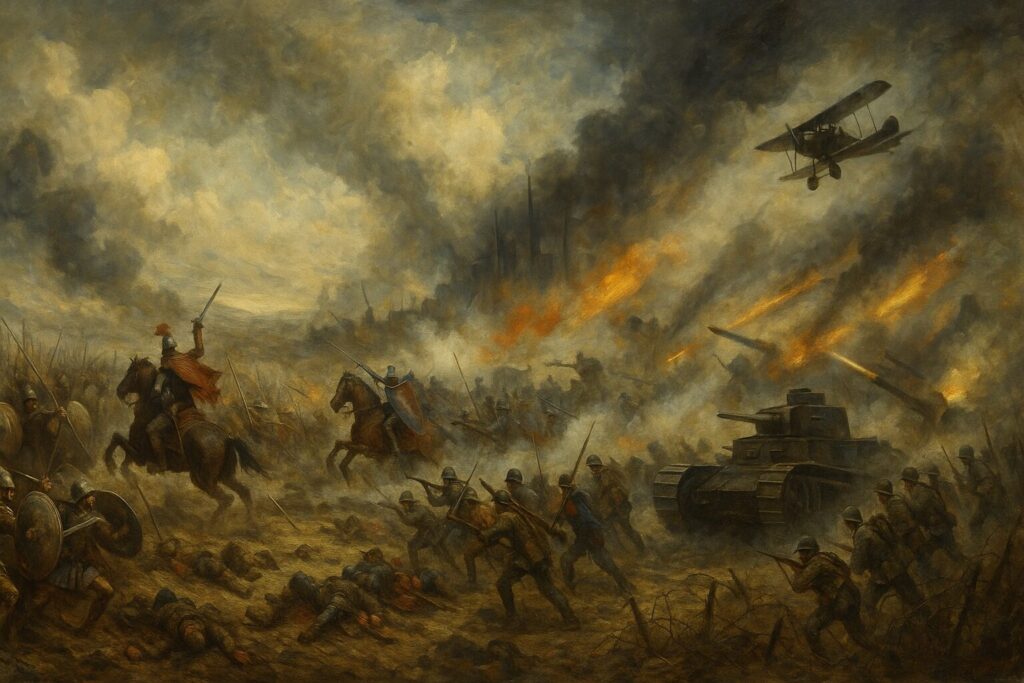
I. Prologue: The Long Road of Violence
War is older than parchment, older than iron, older than the hands that first shaped stone into something sharper than bone.
A man who has walked its centuries, as I have, feels its evolution not as a scholar’s timeline but as the slow tightening of a vise on the human soul.
Each age of warfare presents itself as progress—cleaner lines, sharper steel, more efficient killing. Yet beneath the banners and doctrines, one truth never alters:
War is the organized will of man colliding with the stubborn reality of his neighbor.
And though the weapons change, the wounds they carve into history remain tragically familiar.
II. The Ancient World — When War Was the Anvil of Nations
Phalanx & Shield Wall
In the ancient world, the field belonged to formations—tight, disciplined, unbroken lines of men who trusted the shield beside them more than their own breath.
I have stood in the dust of Marathon, hearing the rumble of Persian cavalry before I even saw their banners. The Greeks won not by strength alone but by unity—one will, one wall, one purpose.
Chariots & the First Maneuver Warfare
Egyptians, Hittites, Chinese dynasties—all sought speed and shock. The chariot was the prototype of the tank: mobility, elevation, and the ability to strike before the enemy could answer.
From these early engines of battle, a pattern emerged:
He who controls movement controls victory.
III. The Medieval & Early Gunpowder Age — Armor Meets the Thunder of Progress
The Knight’s Ascendance
Armor reached its zenith, becoming steel plate wrapped around courage. Yet even the proudest knight could not stand forever against massed pikes or the patient bowmen of England.
I watched Agincourt from a muddy treeline—saw valor drowned by terrain, discipline, and rain-soaked arrows. The age of singular heroism gave way to the primacy of logistics and combined force.
Gunpowder Breaks the Old World
Cannons shattered castle walls that had endured centuries. Muskets replaced the personal duel with impersonal death. Formations widened, battlefields lengthened, and the soldier became part of a machine far larger than himself.
The battlefield was no longer a stage for champions.
It was becoming a system.
IV. The Industrial Wars — Steel, Rail, and the Machinery of Nations
Mass Production of Death
The 19th and early 20th centuries saw empires harness factories to feed the front. Rifles became repeaters. Artillery grew teeth. Railways made war faster, larger, harder to contain.
World Wars: The Century of Fire
I rode inside Soviet steel at Kursk and watched the earth itself recoil beneath the tracks of thousands of tanks. Industrial might became the new phalanx—armies not of men alone but of machines, fuel, and machinery working in concert.
And yet, at night, when the last turret clanged shut, every soldier—no matter the century—still whispered the same prayers.
V. The Modern Era — Invisible Frontiers and Digital Battlefields
Missiles, Satellites, Networks
Today the battlefield extends beyond the horizon. Drones circle like steel hawks. Cyberwarriors fight within silent circuits. Precision weapons strike targets a continent away.
Victory now belongs not merely to the strongest army but to the one with the clearest picture, the fastest data, and the most resilient command.
Yet, despite the sophistication, the cost is unchanged. A mother’s grief does not diminish because the missile was guided by algorithms.
Hybrid Warfare & The Return of the Old
Ironically, modern war has circled back to ancient truths:
- Terrain still matters
- Morale still fractures
- Supply lines still determine fate
- And the human heart remains the battlefield’s most fragile component
VI. Epilogue: The Unbroken Thread
The evolution of warfare is not merely a chronicle of weapons—it is the biography of humanity’s ambition, fear, pride, and desperation. As long as men believe violence can solve what patience cannot, war will continue to innovate.
And I, Friedrich Bargideon, have walked its ages long enough to know:
The wars change. The witness does not.